

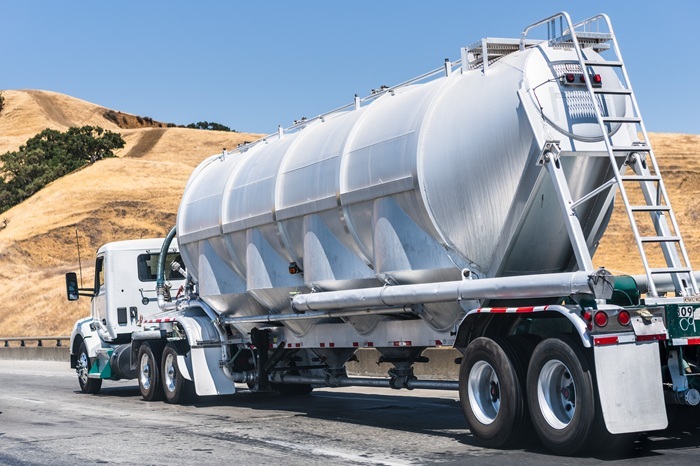
Dry bulk tank operations, including the use of pneumatic trailers and dry bulk carriers, have a different risk profile than liquid tanking or enclosed freight. You’re moving product that can contaminate, absorb moisture, create dust hazards, and be ruined by small process errors—often while using blowers, hoses, and pressurized unloading systems at customer sites.
Most dry bulk tank losses come from a small set of categories like product contamination or misdelivery, unloading/pressurization incidents, rollover and stability risk, and driver injury at the originating or delivery facility.
When you treat unloading as a controlled process rather than as a “routine step,” you reduce the risks that lead to the biggest losses.
SMALL ERRORS, EXPENSIVE OUTCOMES
Dry bulk products—think things like cement, fly ash, lime, plastic resin, grain, feed ingredients, and other powders/pellets—are sensitive to moisture and cross-contamination. A trailer that isn’t cleaned properly or a hatch that isn’t sealed can ruin a load.
Misdelivery is another major driver of claims. For example, blowing the right product into the wrong silo can create cleanout costs, production shutdowns, and customer disputes. The best carriers standardize verification steps at the customer by confirming key information like bin ID, product code, and hose connection before pressurizing the trailer.
uNLOADING AND PRESSURIZATION
Dry bulk unloading inherently includes a unique mechanical risk. Hoses can whip, couplers can fail, valves can be misaligned, and overpressure can damage equipment or even customer infrastructure. These events are often preventable with disciplined operating procedures. Pressure monitoring, lock-out/label practices for valve positions, proper grounding where applicable, and a “stop and verify” pause before the blower is engaged aren’t simply good ideas; they are vital to reduce your risk profile.
Because the highest severity events occur when the truck is parked, driver training and checklists can go a long way in limiting your exposure to a major claim.
And keep in mind that it is not all about your drivers. Facilities can also contribute to risk. Factors like poorly maintained connections, unclear bin labeling, and rushed operations can quickly become issues. Clean documentation that includes photos, delivery notes, and exception logs helps to reduce disputes and speeds resolution when something does go wrong.
HIGHWAY sTABILITY AND DRIVER INJURY EXPOSURE
Dry bulk tanks can have stability challenges depending on load characteristics, center of gravity, and how product shifts in motion. While the cargo is “dry,” it can still behave unpredictably during braking or cornering, increasing rollover exposure. Add the reality of construction sites, plant yards, and narrow access roads, and the risk of significant property damage rises.
Driver injuries are also common. Slips and/or falls from ladders and catwalks, strains handling hoses, and “struck-by hazards” during hook-ups can lead to significant claims. Workers Comp and prevention go hand in hand here. Drivers should put a priority on PPE, three points of contact, and consistent unloading procedures to reduce both injury frequency and claim severity.
go with the name you can trust
At Joe Morten & Son, Inc., we work with trucking operators to protect their bottom lines. If you’re in the market for an agency that puts you first, we’re here to help.
Note: These lists are not intended to be all-inclusive.

We offer commercial trucking coverage in more than 45 states. Check out more information in your state:
Alabama, Arizona, Arkansas, Colorado, Connecticut, Delaware, Florida, Georgia, Idaho, Illinois, Indiana, Iowa, Kansas, Kentucky, Louisiana, Maine, Maryland, Michigan, Minnesota, Mississippi, Missouri, Montana, Nebraska, Nevada, New Hampshire, New Jersey, New Mexico, North Carolina, North Dakota, Ohio, Oklahoma, Oregon, Pennsylvania, Rhode Island, South Carolina, South Dakota, Tennessee, Texas, Utah, Vermont,
Virginia, Washington, West Virginia, Wisconsin, and Wyoming.
Insurance contracts are underwritten, administered, and issued by Great West Casualty Company, Old Republic Life Insurance Company, and Old Republic Union Insurance Company. One or more Old Republic companies may provide the products and/or services described. Information presented is for illustrative purposes only and does not constitute a contract or advice, including employment advice or advice to motor carriers. Please refer to the relevant insurance policy for actual terms. Products and services may not be available in all states and may be subject to change without notice. © 2026 Old Republic International Corporation. Old Republic® and the Old Republic Circle of Stars monogram are registered trademarks. All Rights Reserved.